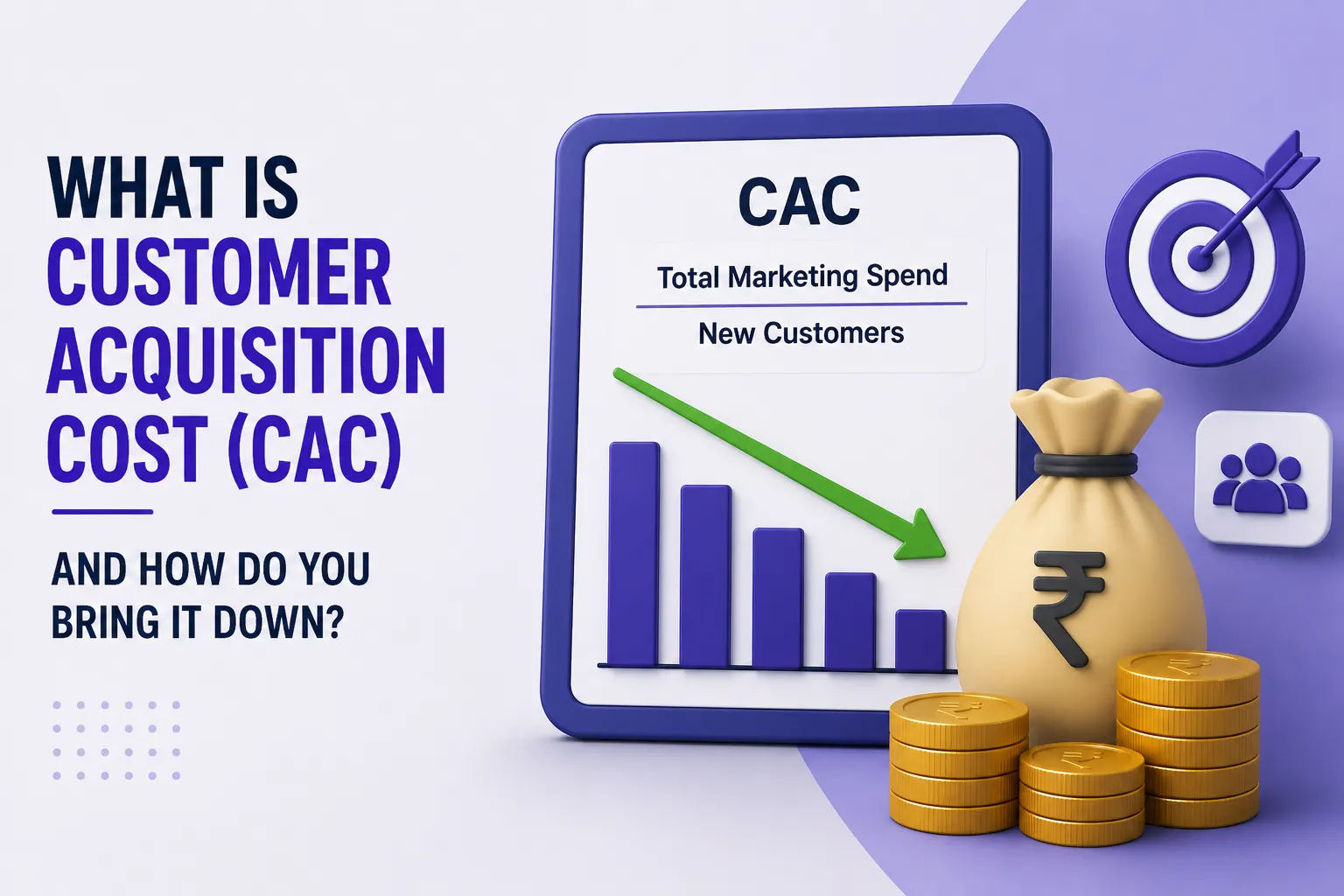
Customer Acquisition Cost — CAC — is the amount you spend on marketing and sales to acquire one paying customer. It is one of the most important numbers in any eCommerce business, and yet most brands either do not track it properly or do not know what to do with it once they do.
The calculation is straightforward: divide your total marketing and sales spend over a period by the number of new customers acquired in that same period. If you spent ₹2,00,000 in a month and acquired 100 new customers, your CAC is ₹2,000.
The important word is "new customers". Including repeat buyers in your denominator will artificially lower your CAC and give you a misleading picture of acquisition efficiency. Track new and returning customers separately.
CAC only makes sense relative to Customer Lifetime Value (LTV). If a customer is worth ₹8,000 to your business over their lifetime, a CAC of ₹2,000 is healthy. If they are worth ₹1,800, your acquisition is structurally loss-making.
Most healthy eCommerce businesses aim for an LTV:CAC ratio of at least 3:1. If yours is below that, you either need to increase LTV (through repeat purchase rates and upsells) or bring down CAC through more efficient performance marketing — and ideally both.
Your blended CAC is an average across all channels. Paid social, Google PPC campaigns, organic SEO, and referrals all contribute at different costs. The mix you invest in determines your overall CAC. High-intent channels like Google Shopping typically deliver lower CAC for eCommerce than broad awareness campaigns.
You can see how different channel mixes affect growth trajectories in the guide on scaling your business with performance marketing.
There are three practical levers. First, improve conversion rates — more buyers from the same traffic spend means lower CAC without reducing budgets. Second, tighten targeting — reaching people closer to buying costs less per customer than broad awareness. Third, improve creative performance — better ads generate more clicks and lower CPMs, reducing cost per conversion.
A fourth lever that is often undervalued is Shopify SEO. Organic traffic from search has no per-click cost. As your SEO rankings improve, a growing share of customers arrive for free — lowering your overall blended CAC month over month.
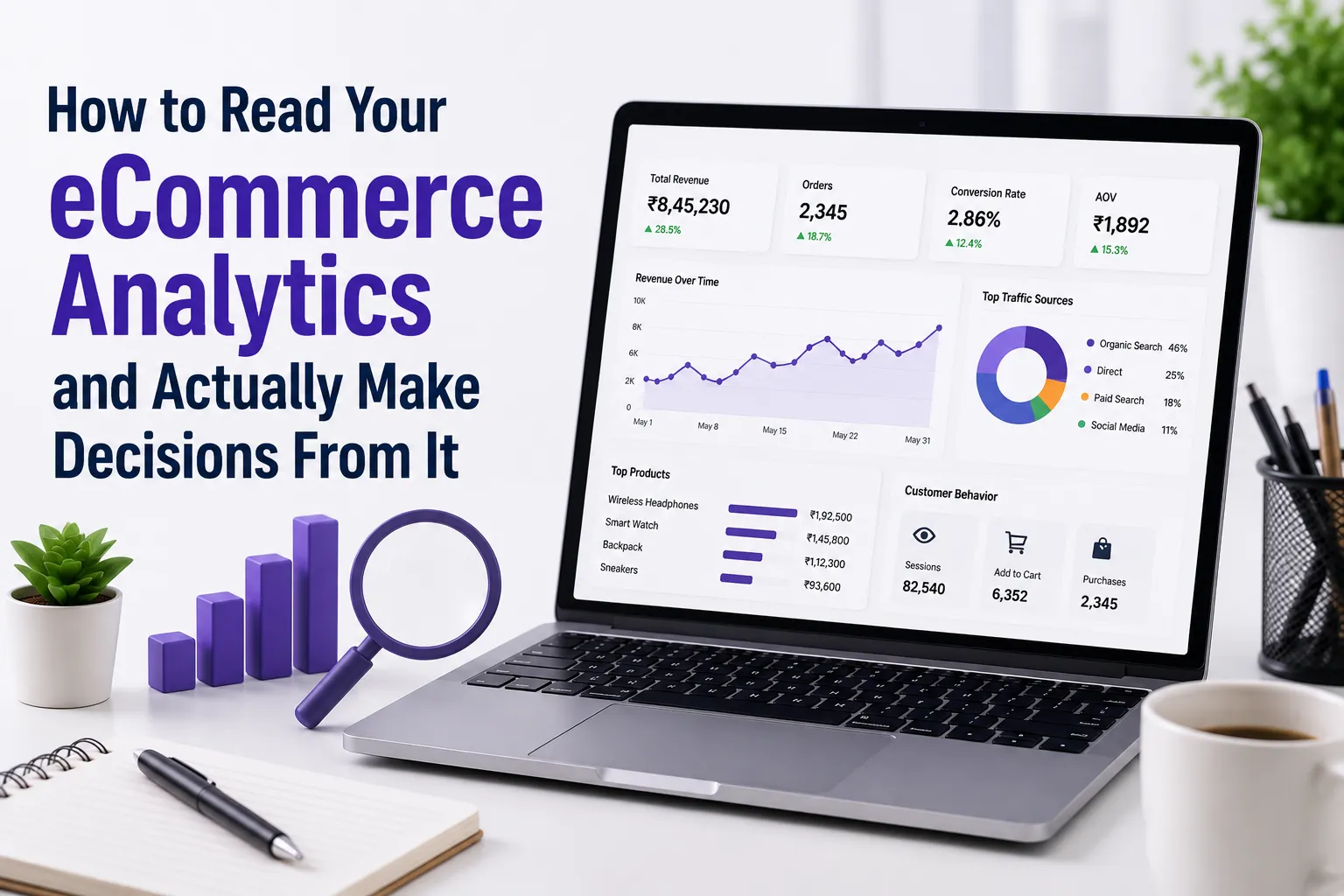
Every campaign generates data that should inform your next one. Which audiences convert at lower CAC? Which ad formats produce the most efficient new customer acquisition? Reviewing CAC by channel monthly — not just ROAS — gives you a clearer picture of where to scale and where to cut.
eCom Conversion is a results-driven performance marketing agency in India that helps eCommerce brands reduce CAC while scaling revenue. Through a combination of PPC, Shopify SEO, and social advertising, we build acquisition engines that improve over time. Speak to the team.
Not exactly. CPA usually refers to the cost per order or conversion event in an ad campaign. CAC is broader — it includes all marketing and sales costs divided by new customers. A campaign CPA might be ₹800, but your blended CAC could be ₹2,000 when all channels and overhead are included.
Monthly is the standard. Calculate it at the channel level and at the blended level. Blended CAC gives you business health; channel-level CAC tells you where to shift budget.
Yes. Higher click-through rates from better creative lower your effective CPM, and better-aligned messaging increases conversion rates. Both directly reduce the cost per new customer.
For a complete picture, yes. CAC should include ad spend, agency fees, tool subscriptions, and any in-house headcount dedicated to growth. Excluding these understates your true acquisition cost.
It varies by category. Fashion and lifestyle brands often see CACs of ₹500–₹2,000 online. Higher-ticket categories like furniture or jewellery can see CACs of ₹3,000–₹8,000. The benchmark that matters most is your own LTV:CAC ratio, not an industry average.

eCom Conversion is rated 4.9 out of 5 on average, based on numerous reviews across social platforms.
We help ecommerce brands grow. Not with guesswork, but with strategies that are tested, refined, and built around your numbers. From Shopify development to paid ads and SEO, we work like an extension of your team, not just another agency you hired.
© Copyright 2026. All Rights Reserved by eCom Conversion.