Most eCommerce brands focus almost all their marketing budget on the bottom of the funnel — trying to convert people who are ready to buy right now. That is understandable, but it creates a ceiling on growth. Understanding the full marketing funnel and where different tactics belong is what allows brands to scale consistently rather than plateau.
The Three Stages of the eCommerce Funnel
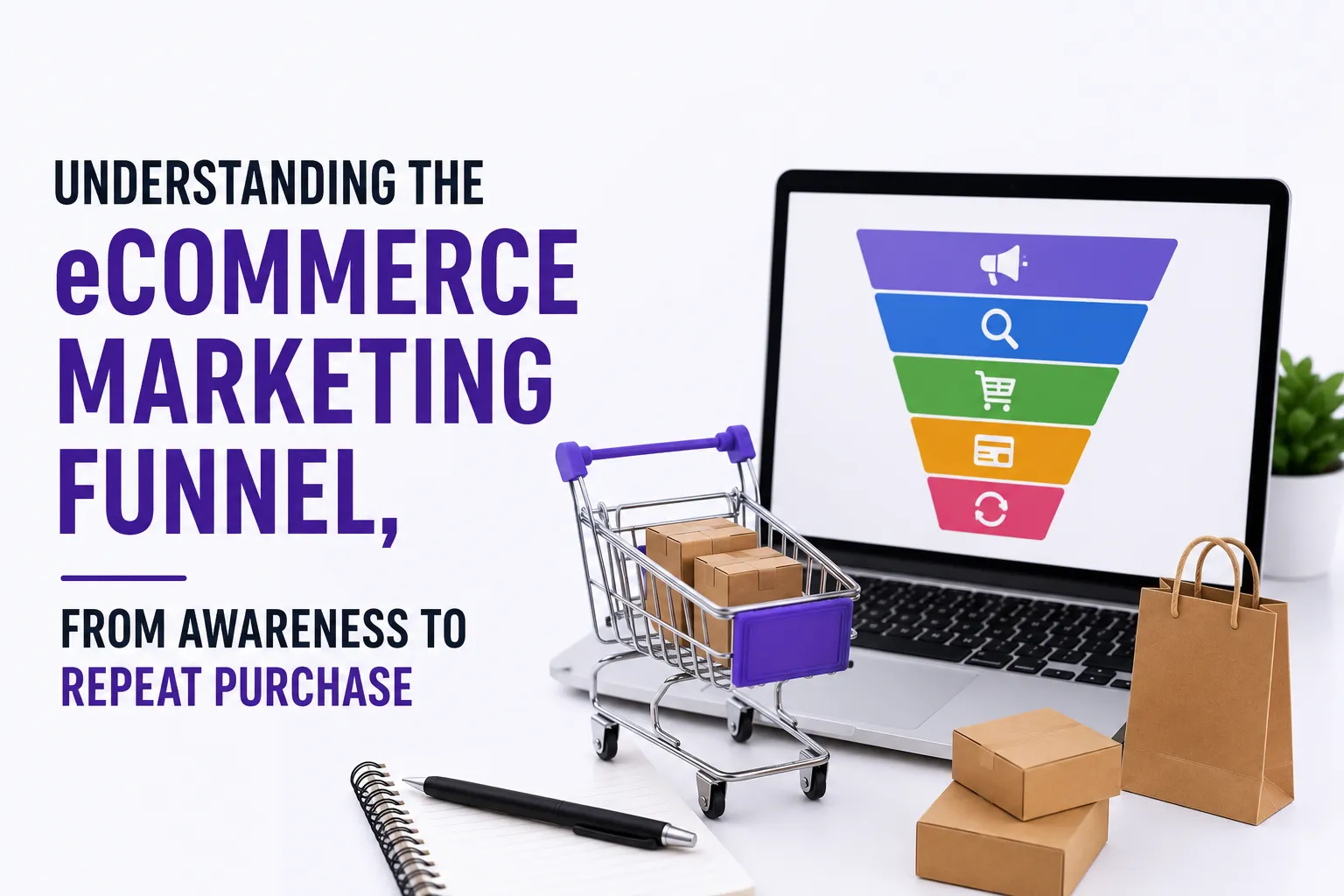
The funnel has three broad stages. Top of funnel (TOFU) is awareness — people who have a problem or desire but have not yet discovered your brand. Middle of funnel (MOFU) is consideration — people evaluating options, comparing products, reading reviews. Bottom of funnel (BOFU) is conversion — people ready to buy, adding to cart, comparing final prices.
Most brands spend heavily on BOFU (Google Shopping, cart abandonment retargeting) and neglect TOFU. The result is that their total addressable audience shrinks over time as they exhaust the pool of people who already know them.
Top of Funnel: Building the Pool
TOFU tactics build brand awareness among people who do not know you yet. Instagram Reels and Facebook video campaigns work well here. So does SEO for informational queries — someone reading "how to care for leather shoes" is not ready to buy yet, but they are in your target audience. Investing in content and Shopify SEO at the top of funnel builds an organic audience that costs nothing to reach repeatedly.
Middle of Funnel: Nurturing Consideration
MOFU is where trust is built. Product comparison content, customer reviews, UGC, and detailed buying guides all serve this stage. Retargeting campaigns that show social proof to people who visited your site but did not convert are classic MOFU tactics.
Email and SMS marketing also live in the middle of the funnel. A visitor who subscribes but has not purchased yet is in consideration mode. A well-structured email sequence — brand story, product highlights, reviews, offer — moves them toward conversion. This is why digital marketing services that span multiple channels tend to outperform single-channel approaches.
Bottom of Funnel: Converting Ready Buyers
BOFU is where your Google PPC campaigns, Product Listing Ads, and cart abandonment retargeting live. These tactics target people with clear purchase intent. Conversion optimisation — page speed, clear CTAs, trust badges, fast checkout — matters most here. Every friction point at BOFU costs you orders directly.
The Funnel Does Not End at Purchase
Post-purchase is the most underinvested stage. A customer who bought once and had a great experience is your lowest-cost next customer. Retention through email, SMS, loyalty programmes, and personalised recommendations dramatically improves LTV — which in turn makes your CAC sustainable at higher levels. You can learn how this connects to campaign structure in the guide on scaling your business with performance marketing.
By audience and objective. TOFU campaigns target cold audiences and optimise for video views, reach, or clicks. MOFU retargets warm audiences and optimises for page views or add-to-carts. BOFU targets high-intent audiences and optimises for purchases.
Not equally. Most eCommerce brands allocate 60–70% to BOFU (fastest, most measurable returns), 20–25% to MOFU (retargeting, consideration), and 10–15% to TOFU (awareness). As brands grow, the TOFU allocation typically increases.
Critical. Email delivers the highest ROI in eCommerce because it is owned media — you are not paying per impression. A subscriber list is one of the most valuable assets a D2C brand can build. Even a small engaged list outperforms a large disengaged one.
Partly. Organic reach has declined on most platforms but has not disappeared. Reels on Instagram still carry organic reach, especially for newer accounts. Most growing brands use paid social to amplify organic content rather than relying on organic reach alone.