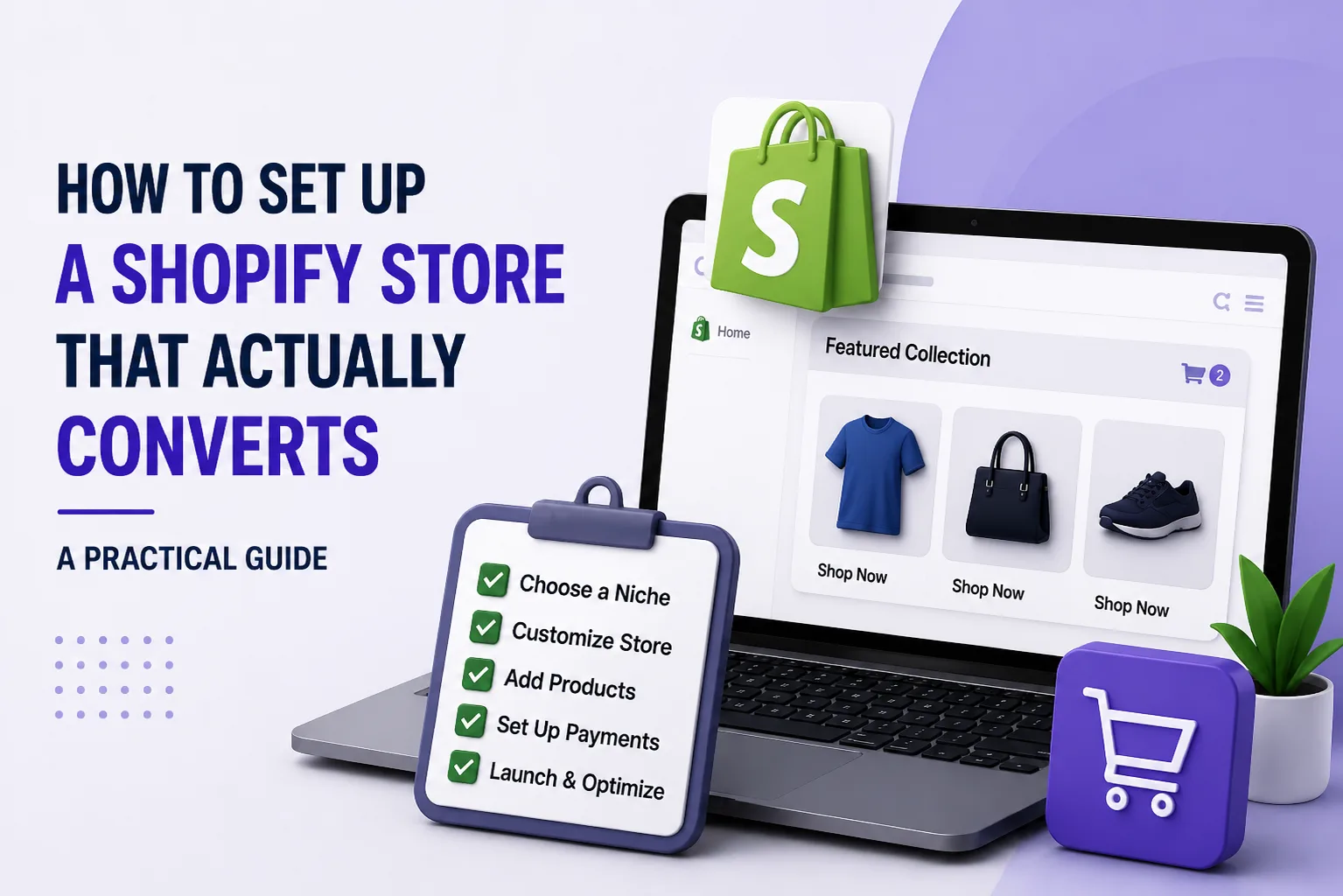
How to Set Up a Shopify Store That Actually Converts, A Practical Guide

A Shopify store that looks professional but loses customers at every step is one of the most common and expensive problems in eCommerce. Getting the setup right from the start — before you pour money into ads — is what separates brands that grow from brands that keep wondering why their traffic does not convert.


How to set up a shopify store that actually converts

Start With Structure, Not Design

Most founders begin with theme selection and colour palettes. The smarter starting point is information architecture — how your products are categorised, how easy it is to navigate between collections, and whether the path from landing page to checkout has any unnecessary friction. Working with a Shopify website development company that structures navigation before styling tends to produce far better conversion results.

Your main navigation should be simple enough that a first-time visitor can find what they are looking for within two clicks. If your category structure requires more than that, it needs to be simplified before launch.


Product Pages That Build Confidence

Your product page is where the purchase decision is made. The three most common conversion killers: images that do not show the product from enough angles, descriptions that list features without explaining what the buyer gains, and missing social proof — no reviews, no ratings, no visible trust signals.

High-converting product pages have multiple image angles including lifestyle shots, a benefit-driven description, visible delivery timelines, a prominent review section, and clear return policies. Every one of these reduces the mental friction a buyer feels before clicking "Add to Cart".

 

Checkout Flow and Reducing Drop-Off

Checkout is where most of the money leaks. Long forms, forced account creation, limited payment options, and unexpected costs at the final step are the top reasons carts are abandoned. Shopify's native checkout is already optimised — but your configuration matters. Enable Shop Pay, offer UPI and COD where your Indian audience expects it, and remove every unnecessary field from the checkout form.


Site Speed Is Non-Negotiable

Page speed affects both conversion rates and your Shopify SEO rankings. A product page that takes more than 3 seconds to load loses a significant portion of mobile visitors before they even see the product. Audit your theme for unused apps, compress images, and run Google PageSpeed Insights regularly. Speed is a continuous maintenance task, not a one-time fix.


Mobile-First Is Not Optional

In India, the majority of eCommerce traffic arrives from mobile devices. Your Shopify store must be designed mobile-first — not just "responsive". Test every key flow (browsing, product selection, cart, checkout) on a mid-range Android device. What breaks for most users rarely breaks on flagship phones. If you are also running performance marketing campaigns to the store, a poor mobile experience will inflate your CPA significantly.

About eCom Conversion

eCom Conversion is a Shopify website development company in India that builds stores optimised for conversion from the ground up — not just visually polished ones. Paired with Shopify SEO and performance marketing, we build growth that compounds. Talk to us about your store.

Frequently Asked Questions

Shopify's own themes (Dawn, Sense, Studio) are well-optimised for performance. Paid themes like Turbo and Prestige are popular for fashion and lifestyle. The theme matters less than how it is configured — a well-set-up free theme outperforms a poorly set-up premium one.

Keep it minimal. Every app adds to your page load time and can conflict with others. Core apps worth keeping: a review app, a cart abandonment or email tool, and your analytics integration. Audit and remove anything you are not actively using.

The average eCommerce conversion rate is 1–3%, with top-performing stores reaching 4–5%. Category plays a big role — food and consumables convert higher than furniture or electronics. Focus on improving your own baseline rather than comparing to broad averages.

Shopify Markets makes it easier to manage multiple currencies and country-specific pricing from one store. For most Indian brands, it is less urgent than fixing domestic conversion rates first.

Significantly. A well-structured store with fast pages, clear product descriptions, and a smooth checkout directly improves ROAS from Google Ads. Poor landing pages are one of the leading causes of high CPC and low ROAS even when campaign targeting is correct.