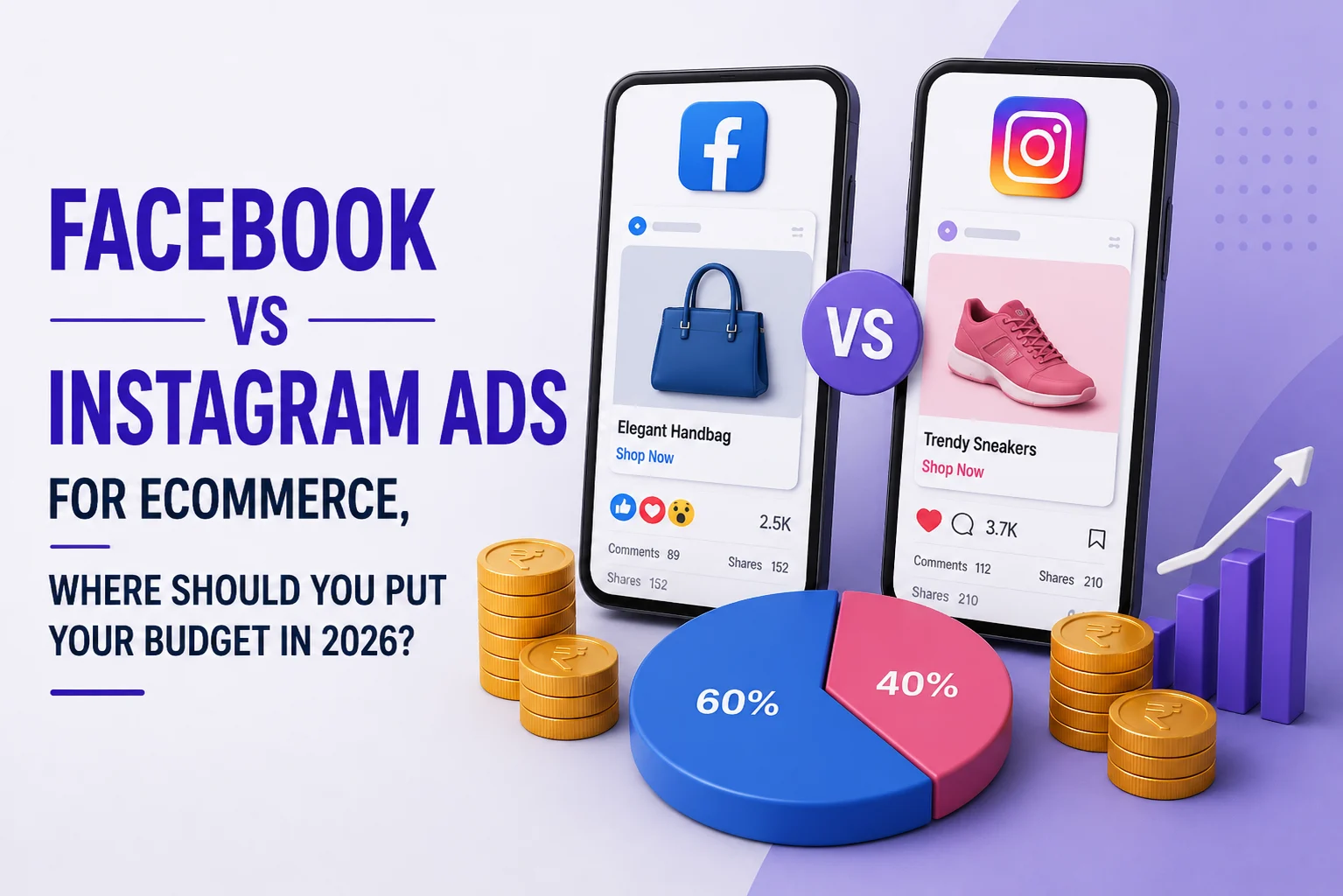
Facebook vs Instagram Ads for eCommerce, Where Should You Put Your Budget in 2026?

Meta's advertising ecosystem gives eCommerce brands access to both Facebook and Instagram simultaneously. But choosing where to concentrate your creative, budget, and energy still matters. The two platforms have different audiences, content formats, and buying behaviours — and treating them as identical is one of the more common mistakes in paid social.


Facebook vs Instagram Ads

Who Is Still on Facebook in 2026?

Facebook's active user base in India skews towards the 30–55 age group — a demographic with higher disposable income and stronger purchasing power. If your products target this segment, Facebook marketing campaigns still deserve serious budget allocation. Facebook also remains stronger for detailed targeting: interest layers, life events, job titles, and lookalike audiences built from your customer list.


Who Is on Instagram and What They Respond To

Instagram's primary audience in India is the 18–34 segment — the sweet spot for most D2C fashion, beauty, lifestyle, and food brands. The platform is visually driven; Reels, Stories, and Explore placements reward high-quality creative far more than Facebook does. Running Instagram marketing campaigns for these categories consistently outperforms Facebook in engagement and purchase intent.

Instagram Shopping has also matured, allowing users to tap directly through to product pages from feed posts and Reels — reducing friction between discovery and purchase significantly.


Cost Differences Between the Two

CPMs on Instagram are typically higher than on Facebook, but this does not mean Instagram is more expensive per conversion. If Instagram's audience is better matched to your product and your creative quality is strong, the higher CPM can still result in a lower CPA. The reverse is also true — running Facebook ads with poor creative or a mismatched audience burns budget fast despite lower CPMs. Platform matters less than audience-creative-offer alignment.


The Case for Running Both

Meta campaigns can be run across both platforms from the same Ads Manager, and in many cases, that is the right approach. You let Meta's algorithm allocate impressions based on where performance is strongest. The important thing is that your digital marketing strategy has a clear brief for each placement — Reels creative is different from a Facebook carousel.

For brands looking at agency selection in Delhi NCR, the piece on top advertising agencies in Noida offers a useful comparison across different capability sets.

About eCom Conversion

eCom Conversion manages Facebook and Instagram marketing campaigns for eCommerce and D2C brands across India — from creative strategy to campaign execution and conversion optimisation. If your Meta spend is not returning what it should, let's look at it together.

Frequently Asked Questions

Technically yes, but it is not recommended. Instagram prioritises vertical, short-form, high-visual content. Facebook supports a wider range of formats. Adapting creative to each placement consistently outperforms running identical assets everywhere.

Both platforms support retargeting. Instagram retargeting tends to perform better for younger audiences and visually driven categories. Facebook retargeting often works better for higher-ticket categories where buyers need more information before purchasing.

Meta Advantage+ Shopping Campaigns (ASC) use AI to automate audience selection and creative delivery. They have shown strong results for eCommerce brands with sufficient conversion data. Worth testing alongside manual campaigns, not as a complete replacement.

Meta's Ads Manager reports both combined and platform-split results. For more accurate attribution, connect your store's revenue data via the Meta Conversions API. This gives a more reliable picture than pixel-only tracking.

For most eCommerce categories, yes. Reels have the widest organic and paid reach on Instagram currently. Brands that invest in short-form video creative consistently see lower CPAs from Reels placements compared to static image ads.