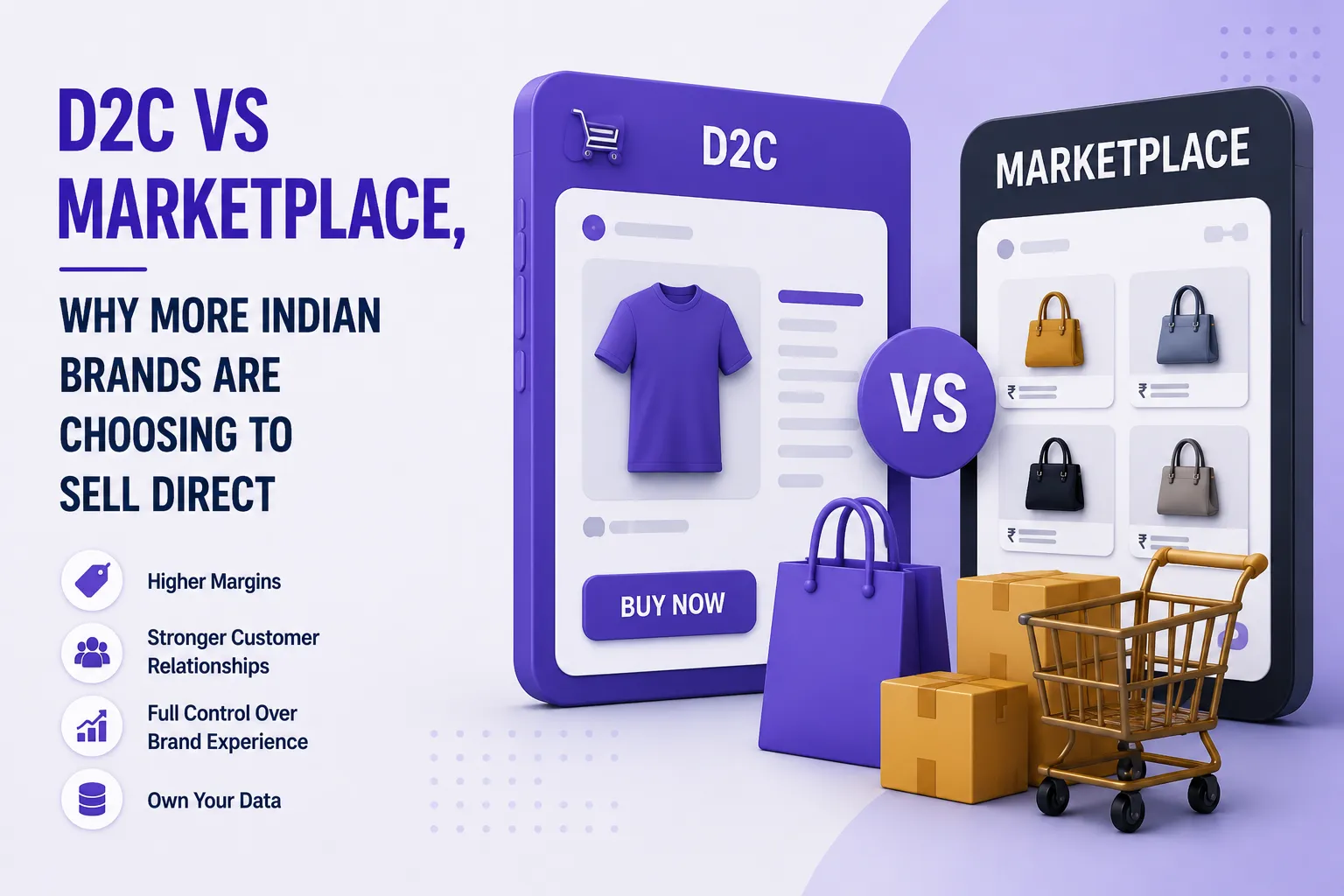
Selling on Amazon or Flipkart gives you instant access to millions of buyers. So why are a growing number of Indian brands choosing to build their own direct-to-consumer (D2C) channels instead? The answer lies in data, margins, and long-term brand control — three things marketplaces simply do not give you.
Marketplaces reduce friction in the early stages. The infrastructure — payments, logistics, discovery — is already built. For brands just entering eCommerce or testing new product lines, this convenience has real value. You can list a product and potentially sell it the same day without building any acquisition capability.
The trade-off shows up quickly. Marketplace commissions range from 10–30% depending on category. Add advertising costs (Amazon Ads, Flipkart Ads) and the margin you are actually keeping per sale becomes surprisingly thin.
When a customer buys from your own website, you own that transaction. You know who they are, what they bought, and when they are likely to buy again. That data is the foundation of retention marketing, product decisions, and LTV growth. On a marketplace, that customer belongs to the platform. Your Shopify store is the asset; the marketplace listing is rent.
D2C also enables brand building in ways marketplaces cannot — your packaging, your post-purchase emails, your loyalty programme, your storytelling. These experiences compound over time and drive repeat purchase rates.

A product selling at ₹1,000 on Amazon with a 20% commission leaves ₹800. Add ₹150 in fulfilment fees and your effective realisation is ₹650 or less. On your own Shopify store, with a ₹200 acquisition cost via PPC, you realise ₹800 — and that customer is now yours to retain for free.
The maths shifts further as your brand's SEO and organic presence grows. Organic traffic to your own store costs nothing per visit. Marketplace rankings require continuous ad spend to maintain.
The smarter play for most brands is not D2C vs marketplace — it is D2C first, marketplace as supplemental. Use marketplaces for discovery and volume in early stages. Invest the revenue into your own store, SEO, and customer list. Gradually shift the mix as your direct channel grows.
Brands that invest in their own digital marketing strategy while maintaining marketplace presence tend to see better margins and stronger brand equity over time. You can explore how this plays out across stages in the top advertising agencies in Noida guide, which covers how D2C brands approach agency selection as they scale.
eCom Conversion helps D2C brands build and scale their own channels — from Shopify store development and Shopify SEO to performance marketing that drives qualified traffic from day one. If you are ready to reduce marketplace dependency and own your growth, let's talk.
Yes. Most brands run both simultaneously. Just ensure your D2C site offers a reason to buy direct — better pricing, exclusive bundles, a loyalty programme — or customers will default to the marketplace they already trust.
Customer acquisition cost in the early stages. Without an existing audience or SEO rankings, you are entirely dependent on paid ads. A solid performance marketing foundation — PPC, social ads — is critical before you can rely on organic channels.
Shopify is the most widely used D2C platform in India and globally. It supports COD, UPI integrations, Razorpay, and all major Indian payment methods. Its SEO capabilities are strong with proper configuration.
Most brands see their D2C channel become meaningfully profitable within 12–18 months when investing in SEO alongside paid channels. Brands relying entirely on paid ads without building organic traffic take longer to achieve sustainable margins.
No fixed minimum, but a narrow catalogue makes SEO and retention harder. Having at least 10–20 SKUs across 2–3 complementary categories gives you enough depth to cross-sell, build category pages for SEO, and retain customers with variety.
eCom Conversion is rated 4.9 out of 5 on average, based on numerous reviews across social platforms.
We help ecommerce brands grow. Not with guesswork, but with strategies that are tested, refined, and built around your numbers. From Shopify development to paid ads and SEO, we work like an extension of your team, not just another agency you hired.
© Copyright 2026. All Rights Reserved by eCom Conversion.