On average, over 95% of first-time website visitors leave without buying. Retargeting is the strategy that brings them back — and for eCommerce brands, it is consistently one of the highest ROAS activities in the entire marketing mix. Yet many brands either skip it entirely or set it up incorrectly and wonder why it is not working.
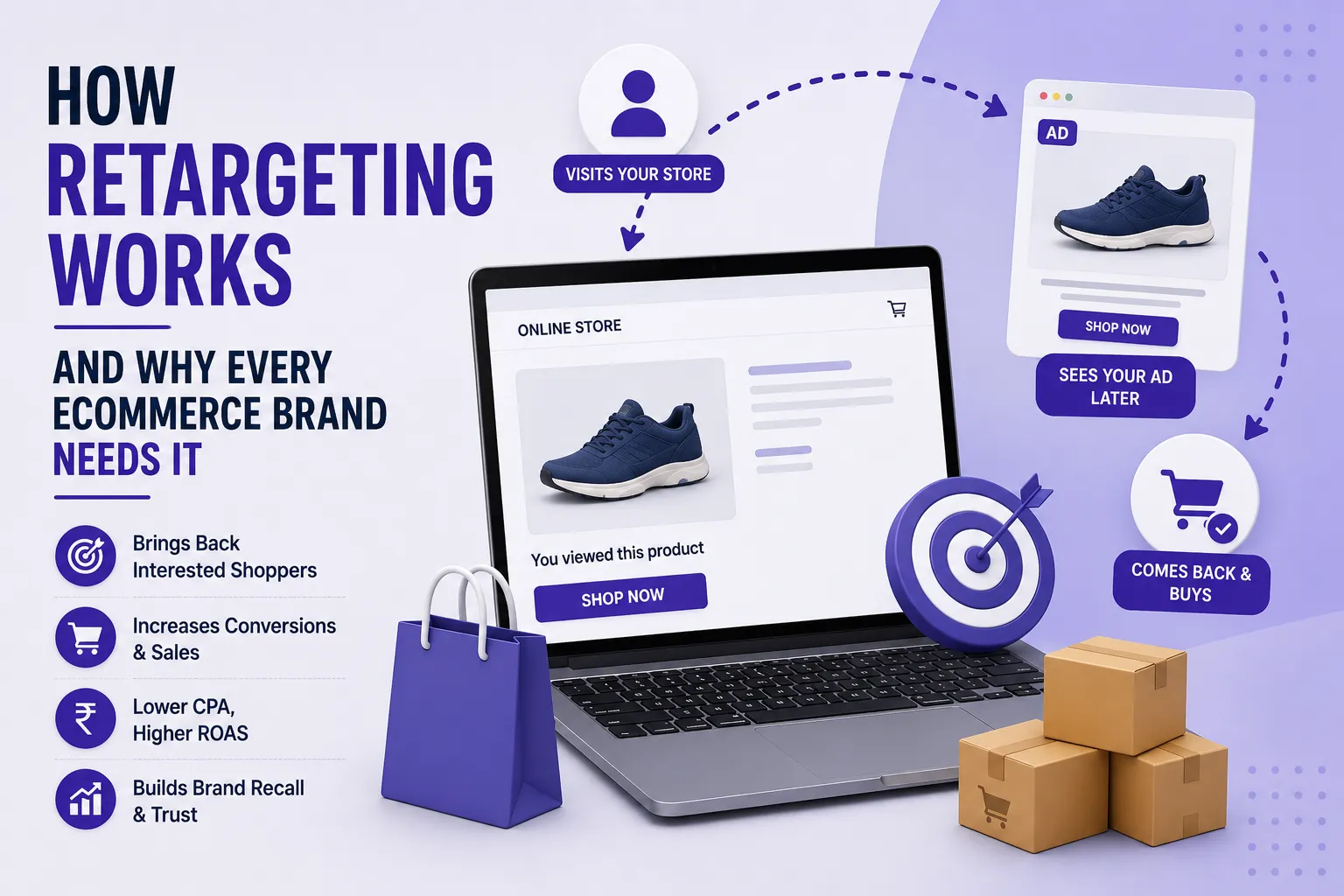
Retargeting means showing ads to people who have previously interacted with your brand — visited your website, viewed a product, added something to their cart, or watched your video. These audiences are warmer than cold traffic because they already know who you are. You are reminding them, not introducing yourself.
Retargeting runs across Google Display and Shopping campaigns, Facebook and Instagram, and other networks. The common thread is that these audiences are defined by your first-party data — your pixel fires and customer lists — rather than interest-based targeting.
People who added products to their cart and did not complete the purchase are your highest-intent retargeting audience. They made it through product discovery, page consideration, and pricing review — then stopped at the final step. A well-timed retargeting ad showing exactly the product they left behind, sometimes with a limited-time offer, is extremely effective.
Cart abandonment retargeting campaigns consistently achieve CPAs 40–60% lower than cold audience campaigns for most eCommerce categories. If you are not running one, this should be the first retargeting campaign you set up.

Beyond cart abandoners: product page viewers (showed intent but did not add to cart), collection page browsers (exploring but undecided), and past purchasers (most likely to buy again). Each audience needs different messaging. Cart abandoners need a reminder and possibly an offer. Collection browsers need to be directed to a specific product. Past buyers need to see new arrivals or related products.
Retargeting is powerful but becomes annoying if frequency is too high. Seeing the same ad for the same product 15 times in a day creates negative brand associations. Cap frequency per audience (7–10 impressions per week is a reasonable starting point), rotate your creative, and set exit windows so people who already purchased are not still seeing ads for what they bought. Managing these settings is part of what a quality performance marketing strategy handles actively.
Dynamic retargeting automatically shows each user the specific products they viewed, populated from your product feed. This is available on both Google (through Product Listing Ads) and Meta. It is highly scalable — you build the template once, and the system fills it with relevant products for each viewer. For catalogues with more than 20 SKUs, dynamic retargeting is almost always worth setting up.
eCom Conversion builds and manages full-funnel retargeting setups for eCommerce brands — from Facebook and Instagram retargeting and Google dynamic remarketing to Product Listing Ads and dynamic product campaigns. Check our case studies or speak to the team.
Most eCommerce brands use 7–30 day windows. Cart abandoners are best targeted within 24–72 hours. Product page viewers can be targeted for up to 30 days. Past purchasers can be targeted for 60–180 days for repeat purchase campaigns.
Retargeting audiences need a minimum size to run — typically 100–1,000 people depending on the platform. If your website gets fewer than 500 visitors per month, grow traffic first before retargeting becomes viable.
The terms are used interchangeably in most contexts. Google uses "remarketing" for its own platform. "Retargeting" is the broader industry term. Both refer to advertising to audiences based on prior website or app interactions.
Yes. On Meta, you can build video view audiences from people who watched a defined percentage of your Reels or feed videos. The higher the percentage watched, the warmer the audience.
Yes. Apple's ATT has reduced the size of iOS-based retargeting audiences on Meta. The workaround is implementing the Meta Conversions API alongside your pixel, which improves event matching using server-side data and is less affected by browser restrictions.
eCom Conversion is rated 4.9 out of 5 on average, based on numerous reviews across social platforms.
We help ecommerce brands grow. Not with guesswork, but with strategies that are tested, refined, and built around your numbers. From Shopify development to paid ads and SEO, we work like an extension of your team, not just another agency you hired.
© Copyright 2026. All Rights Reserved by eCom Conversion.