Most eCommerce brands track a dozen metrics — clicks, impressions, cost per click, website sessions. But if you had to pick one number that tells you whether your advertising is actually working, it would be ROAS: Return on Ad Spend. Understanding it properly can change the way you think about every campaign you run.
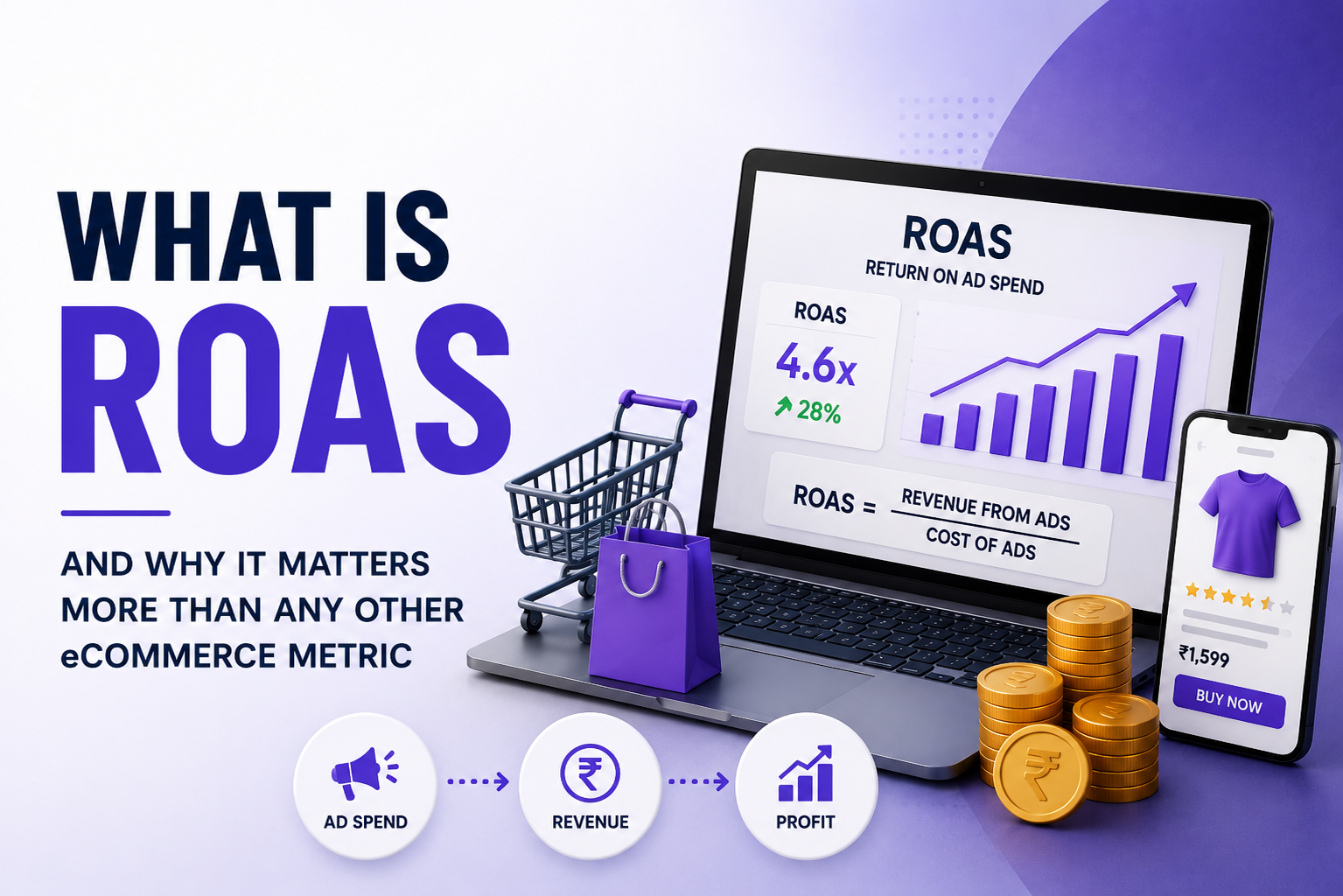
ROAS stands for Return on Ad Spend. It measures how much revenue you earn for every rupee you spend on advertising. The formula is simple: divide your total revenue from ads by the total cost of those ads.
For example, if you spent ₹1,00,000 on Google Ads and generated ₹4,00,000 in sales, your ROAS is 4x. That means every rupee you put in returned four. This is why most brands working with a performance marketing agency in India make ROAS their primary campaign health indicator — it connects ad spend directly to revenue and cuts through the noise of vanity metrics.
These two are often used interchangeably, but they measure different things. ROI (Return on Investment) accounts for all costs — product, shipping, operations, marketing. ROAS only looks at advertising spend vs revenue generated. ROI tells you overall profitability; ROAS tells you how efficient your ads are specifically.
A campaign can have a high ROAS but poor ROI if your product margins are thin. That is why ROAS should always be read alongside your cost of goods and gross margin, not in isolation.

There is no universal benchmark, but a commonly referenced starting point for eCommerce is 4x — ₹4 in revenue for every ₹1 spent. However, what counts as "good" depends heavily on your category, margins, and business model. A high-margin product like branded apparel can sustain at a lower ROAS. A low-margin product like electronics needs a higher one just to break even on ad spend. Before you set a target, work backwards from your gross margin.
ROAS is powerful but has blind spots. It does not tell you about new customer acquisition vs repeat buyers, does not account for attribution lag (especially on Facebook marketing campaigns), and does not reveal whether you are growing the business sustainably. A mature setup tracks ROAS alongside Customer Acquisition Cost (CAC), Lifetime Value (LTV), and blended Marketing Efficiency Ratio (MER).
Better ROAS comes from two levers: spending less to get the same revenue, or earning more from the same spend. Practically, this means tightening audience targeting, improving ad creative quality, optimising landing pages for conversion, and cutting underperforming ad sets rather than letting them drain budget.
One of the most impactful changes brands miss is fixing what happens after the click. Even a well-targeted Google Shopping campaign loses ROAS if the product page is slow, unclear, or missing trust signals. Strong Shopify SEO and store optimisation complements paid campaigns — it improves conversion rates that lift ROAS without increasing spend.
eCom Conversion is a performance-focused digital marketing agency based in Noida, Delhi NCR. With 10+ years of experience and ₹150Cr+ in ad spend managed, the agency works with eCommerce and D2C brands that want real growth — not vanity metrics. From Shopify SEO and PPC management to Facebook marketing and Shopify store development, every service is built around one goal: turning your marketing spend into revenue that compounds. Get in touch with the team today.
No. ROAS measures revenue generated relative to ad spend, not profit. A ROAS of 4x with 20% margins could still leave you at a loss once you account for fulfilment, returns, and overhead.
Yes. Most ad platforms report ROAS natively. For a blended view across Google, Meta, and other channels, you need a centralised analytics setup or a third-party attribution tool.
Target ROAS is a Smart Bidding strategy in Google Ads where the algorithm automatically adjusts bids to hit a ROAS goal you define. It works well once campaigns have at least 30 conversions in the last 30 days.
Google Ads reports ROAS based on last-click attribution by default. Meta uses a 7-day click and 1-day view window, which can inflate reported numbers. Always cross-reference both against actual revenue in your store backend.
ROAS is better when you want to maximise revenue relative to ad spend. CPA (Cost Per Acquisition) is better when you want to control what you pay per order regardless of order value. High-ticket products often benefit more from CPA targets.
eCom Conversion is rated 4.9 out of 5 on average, based on numerous reviews across social platforms.
We help ecommerce brands grow. Not with guesswork, but with strategies that are tested, refined, and built around your numbers. From Shopify development to paid ads and SEO, we work like an extension of your team, not just another agency you hired.
© Copyright 2026. All Rights Reserved by eCom Conversion.